Description
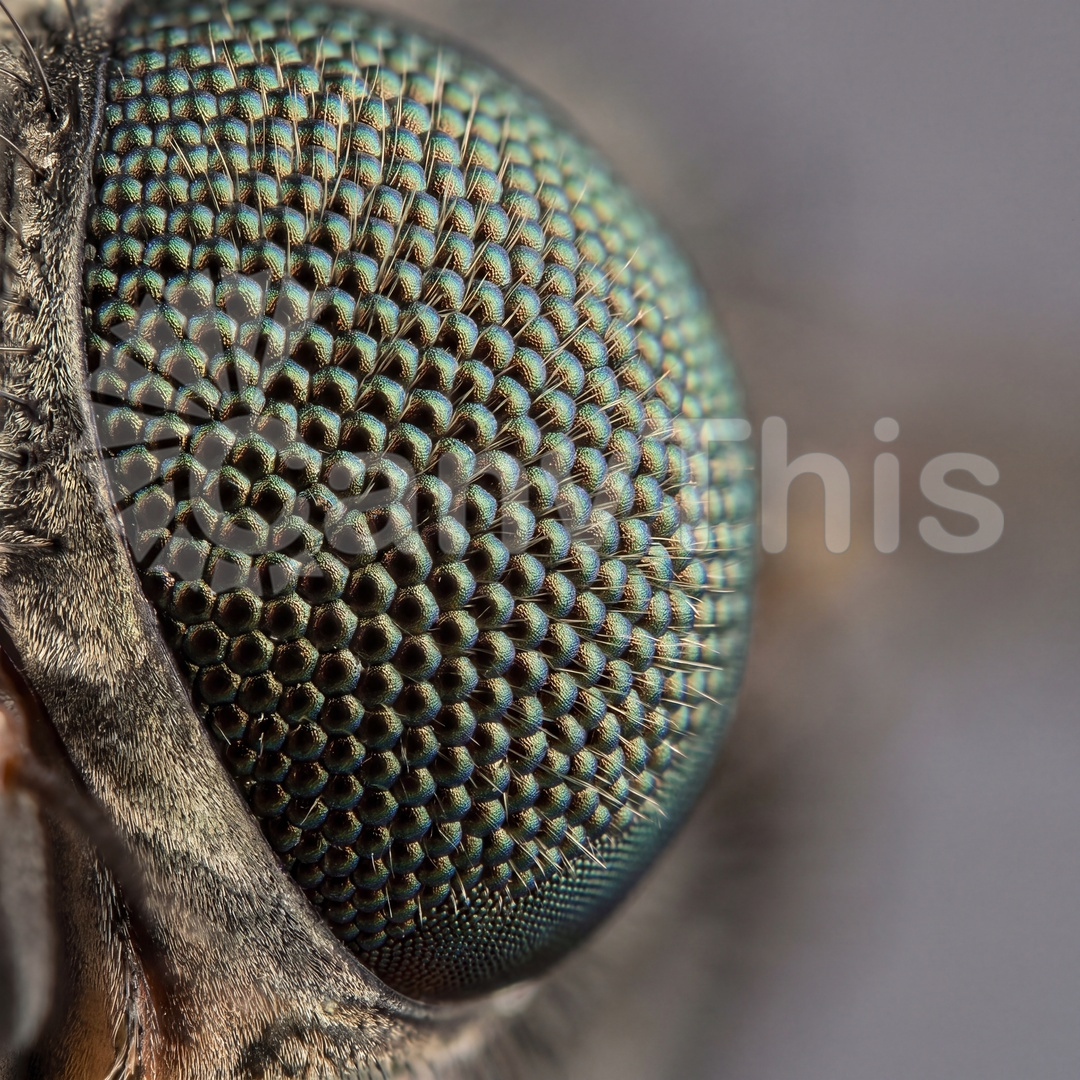
The compound eye of the blowfly (Calliphora vicina) is one of the most studied structures in sensory biology — each eye contains approximately 3,200 ommatidia, each a complete photoreceptor unit consisting of a corneal lens, a crystalline cone, and 8 photoreceptor cells sensitive to green, blue, and UV wavelengths. This photograph, made at 15:1 magnification using a UV fluorescence illumination configuration, reveals the corneal lenses of individual ommatidia as UV-fluorescent elements — the lens cornea fluoresceing blue-white under 365nm UV illumination, the hexagonal lens array creating a tiled pattern of considerable geometrical precision. The image reveals the optics of the compound eye through direct photographic visualization of individual lens elements.