Description
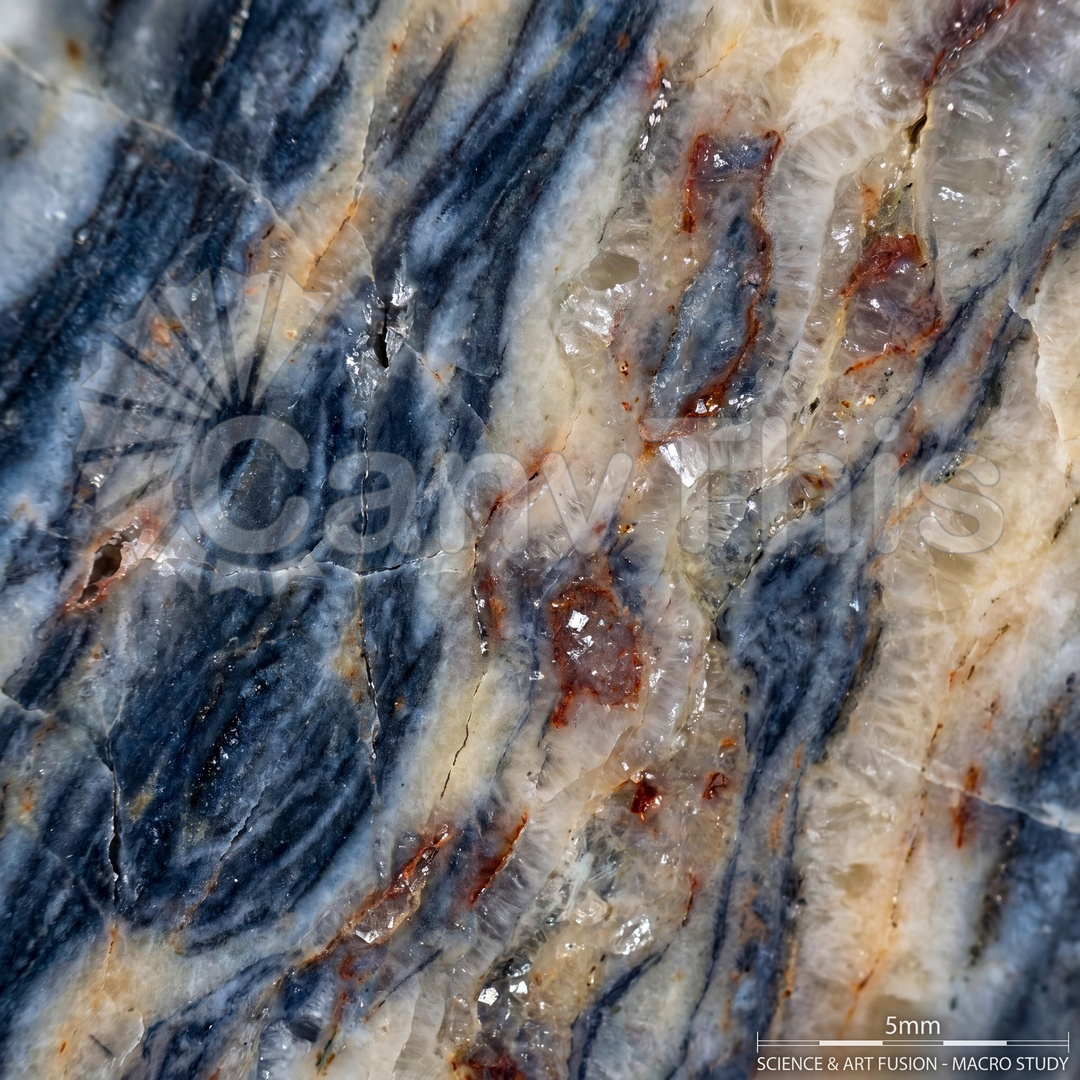
Carrara marble — the material of Michelangelo’s sculptures and of Roman architecture — is composed entirely of calcite crystals recrystallised under heat and pressure from a limestone predecessor. At 2:1 macro reproduction, the white calcite matrix resolves into its constituent crystal structure: the individual crystal grains (approximately 0.1 to 0.5mm), their mutual boundaries, and the larger calcite veins that filled later fractures in the primary rock. The crystal surfaces reflect light as mirror facets at this scale — the image shows not a uniform white but a complex of orientated reflective surfaces, the cleavage planes of individual crystals catching the studio light from specific directions while adjacent crystals appear darker, creating a subtle tonal variation across the white surface. The grey veins that give Carrara marble its characteristic patterning appear at this scale as zones of differently crystallised calcite, their boundaries with the white matrix clearly defined.