Description
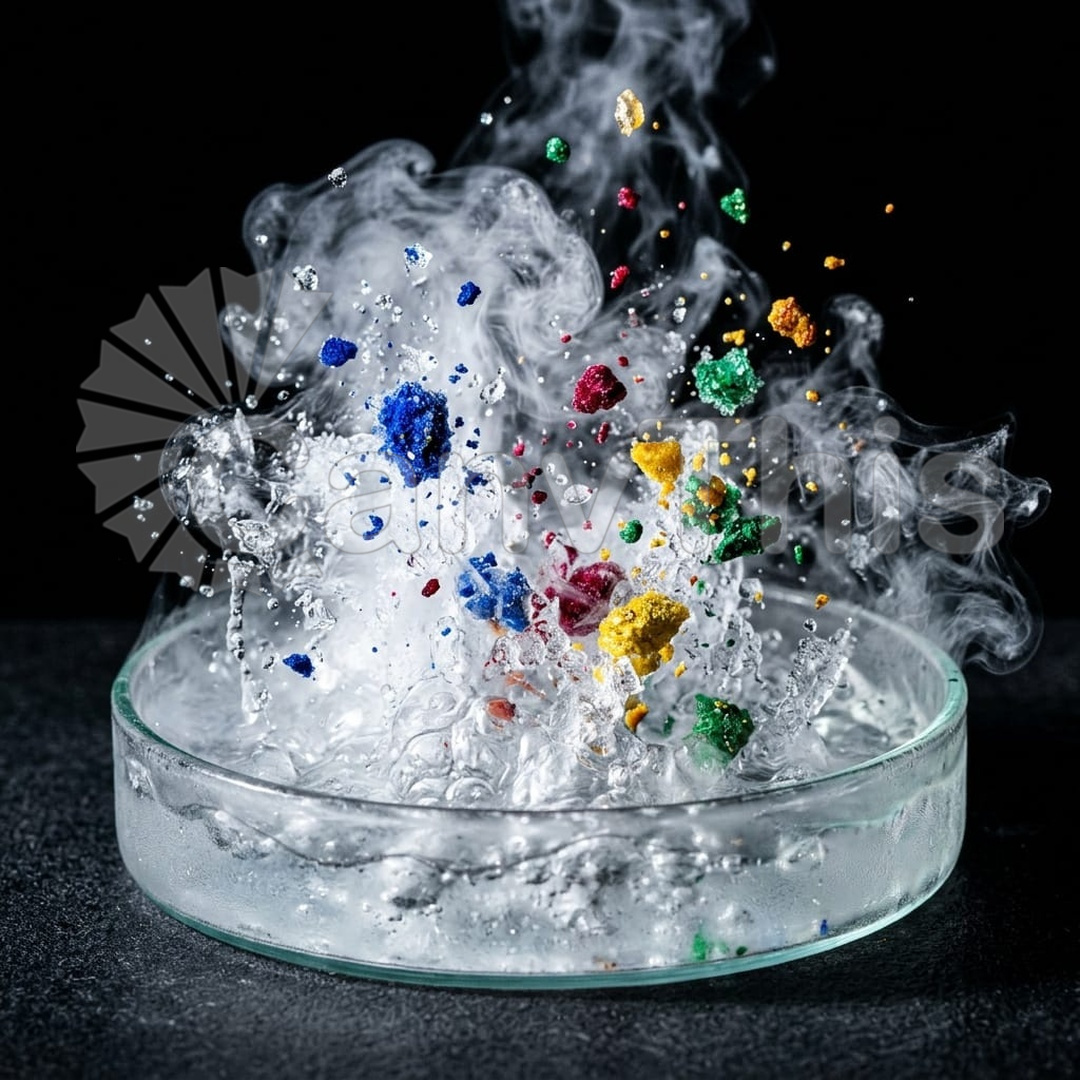
The Leidenfrost effect occurs when a liquid contacts a surface significantly hotter than its boiling point — the immediate vapour flash creates a thermally insulating cushion that supports the liquid droplet above the surface without boiling contact. Liquid nitrogen, with a boiling point of minus 196 degrees Celsius, enters the Leidenfrost regime on any surface above approximately minus 130 degrees Celsius — including room-temperature surfaces. This image was made by introducing liquid nitrogen droplets onto a polished room-temperature steel plate and photographing the droplets in their Leidenfrost state. The droplets are perfectly spherical, supported at approximately 0.1mm above the steel surface on their own nitrogen vapour cushion, and moving freely across the surface as the vapour jet creates a self-propulsion effect. Shot at 1/2000 second against the dark steel background, the pale blue translucency of liquid nitrogen and its vapour halo are clearly visible.