Description
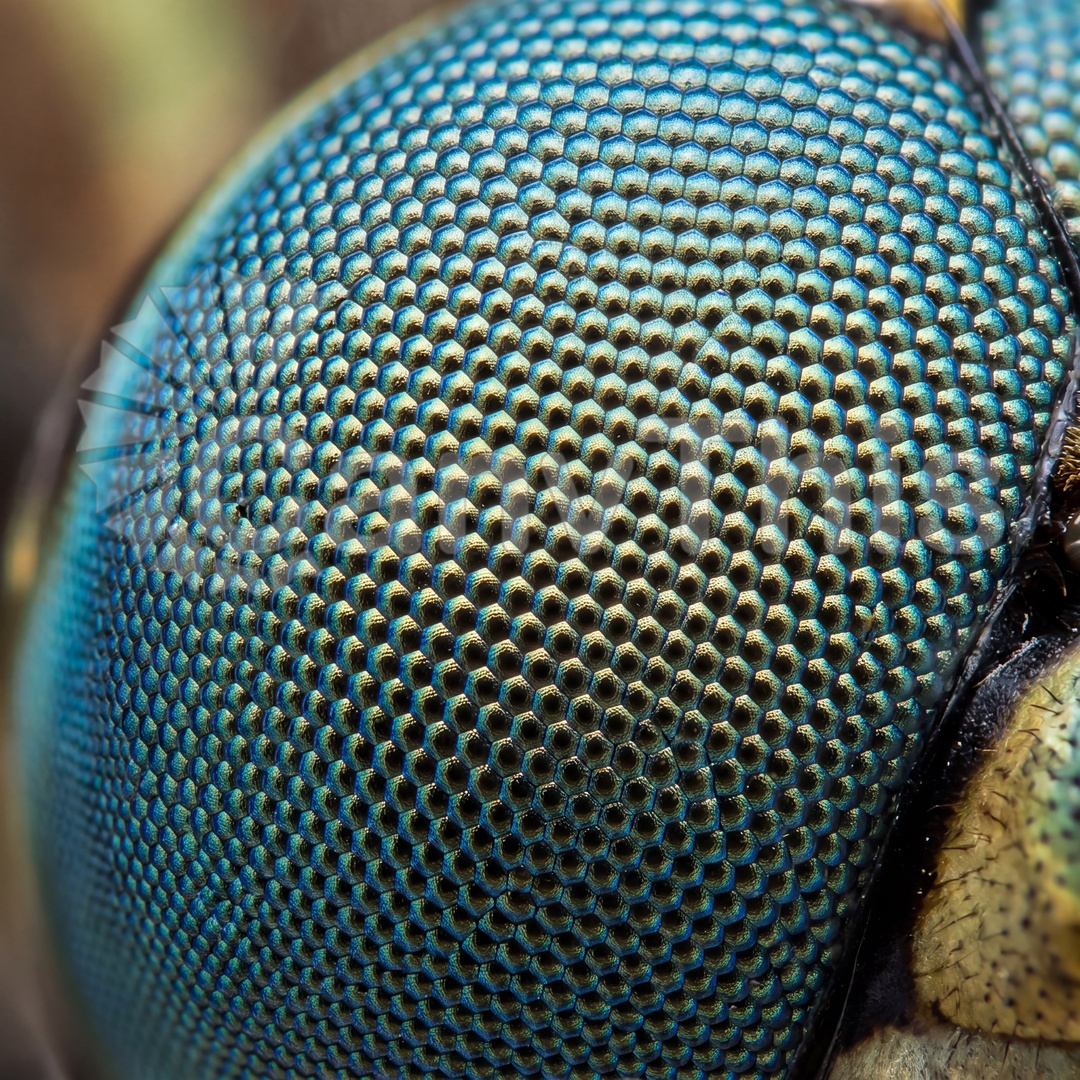
Dragonfly compound eyes are among the most sophisticated visual organs in the insect world — the dorsal acute zone, with facets up to three times larger than the lateral facets, provides the high-acuity binocular vision used for prey detection against the bright sky. At 5:1 macro reproduction, this facet size gradient is clearly legible: the central-dorsal facets are visibly larger — approximately 0.08mm compared to 0.03mm in the lateral zones — and the curvature of the eye’s surface creates a progressive gradient from the acute zone apex to the peripheral facets. This image captures the dorsal surface of a darner dragonfly’s head at 5:1, the compound eye filling the left portion of the frame. The facet array’s lens surfaces are individually resolved, each facet reflecting the studio lighting as a circular catchlight that maps the eye’s three-dimensional curvature. The transition between the different-sized facets of the acute zone and the peripheral zones is visible as a subtle change in surface texture across the eye.